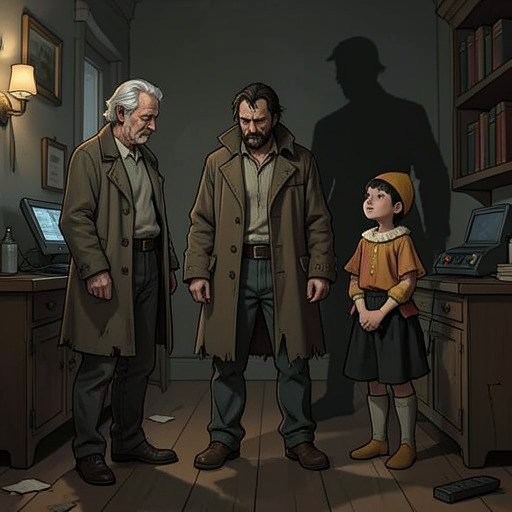
The Woodcutter's Marriage to His Wife
Hansel and GretelThe Woodcutter's Marriage to His Wife becomes a conflict over whether the household will protect or sacrifice the Woodcutter's children. After their mother dies, he remarries, but famine turns the marriage into a contest between his attachment to Hansel and Gretel and the Stepmother's insistence that the family cannot survive together. His eventual remorse, and the Stepmother's death before the children's final return, mark the end of that conflict.
Marriage and Household
The Woodcutter has two children, Hansel and Gretel, and marries again after their mother has died. The new marriage places the Stepmother in the same household as the children, but the story gives no account of courtship or of the couple's life before the famine. Their relationship is instead defined through decisions made under deprivation and their sharply different responses to those decisions. When famine leaves the family with almost nothing to eat, the Stepmother argues that all four will not survive another winter. She proposes taking the children into the deepest part of the forest, giving them bread, and leaving them there so they cannot find their way home. The Woodcutter refuses at first: he loves his children and recognizes that they could starve or be killed by wild animals. The dispute makes the stakes of the marriage plain: his affection resists her plan, but her persistent argument eventually overcomes his refusal.
First Abandonment and Return
The couple carry out the plan together, taking the children into the forest and leaving them beside a fire under the pretense that they should wait while their parents work. The Stepmother also arranges a branch to make a clapping sound in the wind, leading the children to believe that their father is still nearby. The deception helps conceal the abandonment, while the Woodcutter's participation makes him responsible for it despite his earlier objections. Hansel's white stones allow the children to find their way home. The Stepmother is furious when they arrive, but the Woodcutter is immensely glad to see them and regrets what he has done. For a time, the four live together again. His welcome does not undo his choice to abandon them, but it shows that the marriage has not erased his attachment to his children or his awareness of the harm he has caused.
Renewed Famine and Separation
A few days later, a famine more terrible than the first devastates the region. The Woodcutter again does not want to separate from the children, yet the Stepmother once more convinces him that abandonment is the only solution. This repetition gives their marital conflict a pattern: he resists, she presses the same survival argument, and he yields again. The second plan is harder for Hansel to counter. The Stepmother has locked the door so he cannot slip outside to collect white stones; he instead drops bread crumbs along the route. The parents again leave the children beside a fire in the forest, but birds eat the crumbs, destroying the children's means of tracing their way home. The couple's second decision thus turns a temporary separation into a far more perilous one, with no reliable trail back to the household.
Remorse and the Marriage's End
After Hansel and Gretel escape the Witch and make their way home, the Woodcutter receives them with joy. He tells them that the Stepmother has died and will never hurt them again; the story does not explain when or how her death occurred. He also confesses, through his conduct and his account of his regret, that he has lamented abandoning them every day since it happened. The children bring back precious stones and pearls from the Witch's house, and their return ends the family's material need as well as its separation. The Woodcutter's marriage is no longer part of the restored household: the Stepmother is dead, while he is reunited with the children whose abandonment he regretted. The ending reverses the famine that had furnished the couple's justification for leaving them, but it does not present the Woodcutter's remorse as a substitute for the danger his repeated compliance exposed them to.